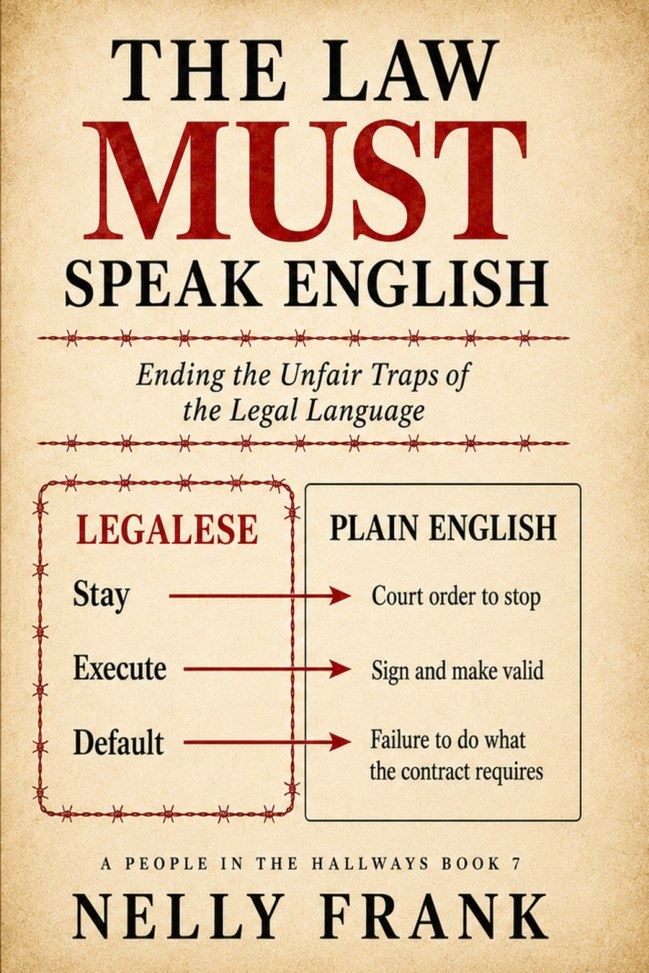
The Law Must Speak English
Ending the Unfair Traps of the Legal Language
Synopsis
What good are rules if the people who must follow them cannot understand them?
Students and neighbors begin asking why the language of law and public institutions so often seems written for specialists rather than the public. Their questions grow into a shared effort to make complicated rules more understandable—and to challenge the assumption that confusion is simply something ordinary people must accept.
As they confront the distance between official language and everyday life, they discover that clear communication is not a minor convenience. It can shape people's confidence, choices, and ability to participate in the decisions that affect them.
Why I Wrote This Book
Author review draft — wording subject to Nelly Frank’s approval.
I wrote The Law Must Speak English because I wanted to ask a question that sounds simple but has serious consequences: what does it mean for the law to be understandable to the people expected to obey it?
Legal language has a purpose. Precise words can help define responsibilities and protect rights. But precision loses much of its value when the person receiving an important notice or explanation cannot make sense of what it says. A document may be written in English and still feel like a foreign language to an ordinary reader.
I have spent much of my professional life concerned with teaching and communication. That experience has made me attentive to the distance between what an expert believes has been explained and what another person has actually understood. The distance becomes especially important when a mistake, a missed deadline, or an unclear instruction can change someone's life.
In this novel I wanted readers to encounter that problem through people, not through a lecture. The characters face situations in which words carry consequences, and they must decide when to ask questions, when to seek qualified assistance, and how to make themselves heard.
I do not believe complex legal questions can always be reduced to a few simple sentences. I do believe institutions should make a serious effort to communicate clearly and should recognize that comprehension cannot be assumed merely because information has been delivered.
This is fiction, not legal advice. My hope is that the story entertains readers while encouraging a practical habit: before we accept that something has been explained, we should ask whether the person receiving the explanation truly understands it.
Topics, Themes & Issues
Plain languageEducationCivic participationDemocracy
What Will You Take Away From This Story?
Understanding is part of fairness. Ask what it means to have rights when official language prevents people from understanding documents that shape their lives.
The story ends. Its values live on.
Reader resources
Continue the conversation with the reader discussion questions and companion program. Specialized guides are being developed and verified.
Book-specific resources are being inventoried and checked.
For a classroom activity on clear document reading, see the IDEAL Method guide from The Helper Has to Be Mute. It aligns with the themes of plain language and civic understanding explored in Book 7. Explore the IDEAL Method book club and book club and classroom guide →
Amazon editions
Edition links are provided for convenience; check Amazon for current availability and pricing.